1 The Role of Statistics in Engineering

TipMajor Themes of Chapter 1
  • Engineering Method: Understanding how statistics supports engineering problem-solving through systematic data analysis

  • Data Collection: Learning different methods for gathering engineering data, from historical records to controlled experiments

  • Variability: Recognizing and quantifying uncertainty in engineering systems as a fundamental aspect of real-world processes

  • Statistical Thinking: Developing a framework for data-driven decision making that considers uncertainty and variation

  • Process Monitoring: Observing and controlling engineering processes over time using statistical methods

ImportantLearning Objectives

After careful study of this chapter, you should be able to do the following:

  1. Identify the role that statistics can play in the engineering problem-solving process.

  2. Discuss how variability affects data collected and used in making decisions.

  3. Discuss the methods that engineers use to collect data.

  4. Explain the importance of random samples.

  5. Identify the advantages of designed experiments in data collection.

  6. Distinguish between mechanistic and empirical models.

  7. Apply statistical thinking to process monitoring over time.

1.1 The Engineering Method and Statistical Thinking

NoteThe engineering problem-solving method

Engineering Foundation: Engineers solve problems of interest to society by the efficient application of scientific principles. The engineering or scientific method is the approach to formulating and solving these problems.

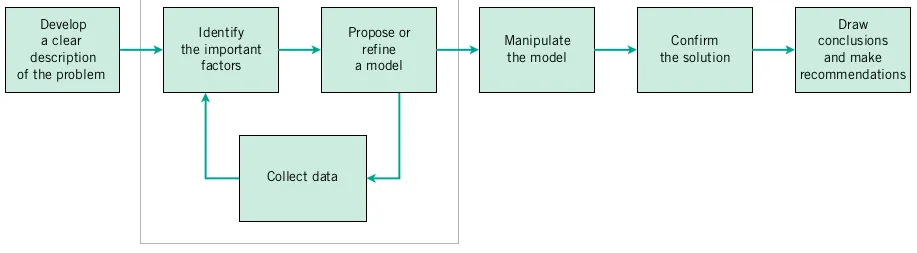
Let’s review the steps in this process.

  1. Develop a clear and concise description of the problem.
  2. Identify, at least tentatively, the factors that affect this problem or may play a role in its solution.
  3. Propose a model for the problem, using scientific or engineering knowledge of the phenomenon being studied. State any limitations or assumptions of the model.
  4. Conduct appropriate experiments and collect data to test or validate the tentative model or conclusions in steps 2 and 3.
  5. Refine the model based on the observed data (repeating steps 2 through 5 as needed).
  6. Manipulate the model to assist in developing a solution to the problem.
  7. Conduct an appropriate experiment to confirm the effectiveness and efficiency of the proposed solution.
  8. Draw conclusions or make recommendations based on the problem solution.
Figure 1: The engineering problem-solving method.

Statistical Integration: In today’s data-driven engineering environment, statistical methods are essential tools that complement traditional engineering analysis, helping engineers make sense of uncertain, variable data and draw reliable conclusions.

1.1.1 The Role of Statistics in Engineering

NoteStatistics in Engineering Problem-Solving

Statistics plays a crucial role in each phase of the engineering method:

1. Problem Recognition and Definition

  • Helps identify patterns in data that indicate problems

  • Quantifies the magnitude and frequency of issues

  • Provides tools for problem prioritization

2. Hypothesis Formation

  • Uses data analysis to suggest potential causes

  • Applies statistical models to test theories

  • Employs correlation analysis to identify relationships

3. Data Collection and Analysis

  • Designs efficient experiments and sampling plans

  • Provides methods for data quality assessment

  • Offers tools for exploratory data analysis

4. Conclusion and Decision Making

  • Quantifies uncertainty in results

  • Provides confidence intervals and hypothesis tests

  • Enables risk-based decision making

1.1.2 Example: Engineering Problem-Solving with Statistics

NoteExample: Manufacturing Process Investigation

Engineering Context: A manufacturing engineer notices increased variability in product dimensions, which could lead to quality issues and customer complaints. This demonstrates systematic application of statistical methods to engineering problem-solving.

[1] "Manufacturing Problem Example - Step by Step Analysis"
Variability Comparison Between Time Periods
period count mean_dimension std_dev min_value max_value
First_Half 15 50.322 0.148 50.172 50.587
Second_Half 15 49.731 0.138 49.528 49.976
Analysis by Operator
operator count mean_dimension std_dev
A 10 49.940 0.290
B 10 50.206 0.327
C 10 49.934 0.332
[1] "Temperature-Dimension Correlation: 0.249"

Statistical Analysis Steps:

  1. Problem Recognition: Control charts show process instability

  2. Hypothesis Formation: Possible causes include temperature, operator, or material variation

  3. Data Collection: Design experiment to test factors systematically

  4. Analysis and Conclusion: Statistical tests identify significant factors

1.1.3 Probability and Statistics Fundamentals

Probability

NoteProbability
  • Used to quantify likelihood or chance

  • Used to represent risk or uncertainty in engineering applications

  • Can be interpreted as our degree of belief or relative frequency

Key Probability Concepts:

  • Sample Space (S): Set of all possible outcomes

  • Event (A): Subset of the sample space

  • Probability P(A): Measure of likelihood, where 0 ≤ P(A) ≤ 1

Engineering Applications:

  • Reliability analysis: P(component failure)

  • Quality control: P(defective product)

  • Risk assessment: P(system malfunction)

Statistics

NoteStatistics

Deals with the collection, presentation, analysis, and use of data to:

  • Make decisions

  • Solve problems

  • Design products and processes

Statistical techniques are useful for describing and understanding variability. By variability, we mean successive observations of a system or phenomenon do not produce exactly the same result.

Statistics gives us a framework for describing this variability and for learning about potential sources of variability.

1.1.4 Statistical Reasoning

NoteStatistical Reasoning

Statistics is the science of uncertainty & variability

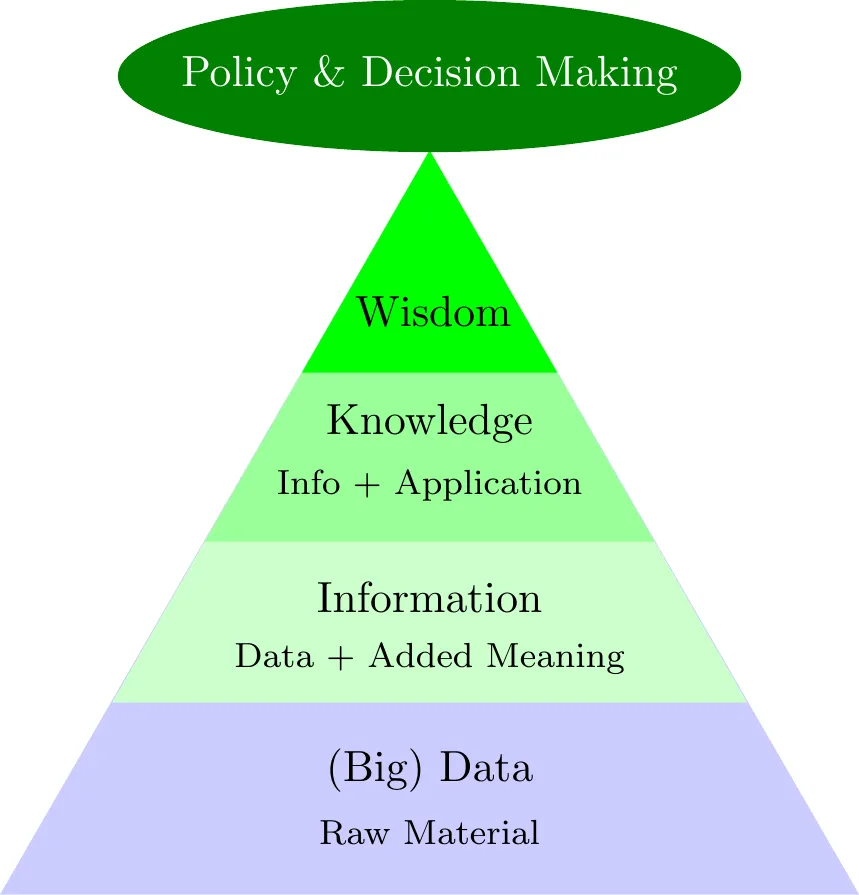
Turning Data into Information:

DataInformationKnowledgeWisdom

Figure 2: Big Data in Engineering

Statistics is the Art and Science of learning from Data.

The Statistical Thinking Process:

  1. Recognize the need for data-based decisions

  2. Understand the importance of data quality

  3. Appreciate the role of variability

  4. Use appropriate statistical methods

  5. Communicate results effectively

1.1.5 Key Definitions and Concepts

NoteEssential Definitions

Population

  • Set of measurements of interest. Characteristics of the population (parameters) are typically of interest.

Sample

  • Subset of measurements of interest. A characteristic of the sample (statistic) is used to infer population characteristics (parameters).

Parameter

  • A characteristic of the population (usually unknown and estimated from sample data).

Statistic

  • A characteristic of the sample (computed from observed data).

Descriptive Statistics

  • Describing the important characteristics of a set of data.

Inferential Statistics

  • Using sample data to make inferences (or generalizations) about a population.

Statistical Inference

  • Making a statement about the population (parameter) based on the sample (statistic).

1.1.6 Example: Population vs. Sample

NoteExample: O-Ring Development for Semiconductor Equipment

Engineering Context: An engineer is developing a rubber compound for use in O-rings. The O-rings are to be employed as seals in plasma etching tools used in the semiconductor industry, so their resistance to acids and other corrosive substances is an important characteristic.

The engineer uses the standard rubber compound to produce eight O-rings in a development laboratory and measures the tensile strength of each specimen after immersion in a nitric acid solution at 30°C for 25 minutes. The tensile strengths (in psi) of the eight O-rings are 1030, 1035, 1020, 1049, 1028, 1026, 1019, and 1010.

O-Ring Sample Statistics & Confidence Interval
sample_size sample_mean sample_median sample_std_dev sample_min sample_max std_error t_value margin_error ci_lower ci_upper
8 1027.1 1027 11.7 1010 1049 4.14 2.36 9.8 1017.3 1036.9

Analysis:

  • Population: All possible O-rings made with this rubber compound

  • Sample: The eight O-rings tested (n = 8)

  • Parameter: True mean tensile strength (μ) of all O-rings

  • Statistic: Sample mean tensile strength (x̄ = 1027.1 psi)

As we should have anticipated, not all the O-ring specimens exhibit the same measurement of tensile strength.
1.1.7 Random Variables and Variability

NoteRandom Variable

Since tensile strength varies or exhibits variability, it is a random variable.

A random variable X can be modeled by:

X = \mu + \epsilon

where μ is a constant and ε is a random disturbance, or “noise” term.

Sources of Variability:

  • Common Causes: Natural variation inherent in the process

  • Special Causes: Unusual events that create additional variation

  • Measurement Error: Variation due to measurement system

  • Environmental Factors: Temperature, humidity, vibration effects

1.2 Collecting Engineering Data

NoteCollecting Engineering Data

Three basic methods for collecting data:

  • A retrospective study using historical data

  • An observational study

  • A designed experiment

Choosing the Right Method:

The choice depends on:

  • Available resources and time

  • Level of control over variables

  • Objective of the study

  • Ethical and practical constraints

1.2.1 Retrospective Study

NoteRetrospective Study

A retrospective study uses either all or a sample of the historical process data from some period of time. The objective of this study might be to determine the relationships among variables like temperature and concentration in a chemical process.

Advantages:

  • Data already exists (cost-effective)

  • Large datasets often available

  • No disruption to current operations

Disadvantages:

  • Data quality may be poor

  • Important variables may not have been recorded

  • Confounding variables difficult to control

  • Causation difficult to establish

1.2.2 Example: Retrospective Study

NoteExample: Chemical Plant Process Analysis

A chemical plant wants to improve acetone concentration in their output. They have 6 months of historical data including temperature, pressure, and acetone concentration.

Historical Data Summary (6 months)
total_days avg_temperature avg_pressure avg_acetone
181 84.8 2.5 153.6
Weekend vs Weekday Comparison
is_weekend number_of_days avg_acetone
FALSE 130 153.8
TRUE 51 153.0

Analysis Approach:

  1. Data Cleaning: Check for missing values and outliers

  2. Exploratory Analysis: Examine relationships between variables

  3. Statistical Modeling: Develop predictive models

  4. Validation: Test model performance on recent data

1.2.3 Observational Study

NoteObservational Study

An observational study simply observes the process or population during a period of routine operation without making deliberate changes to the system.

Types of Observational Studies:

  • Cross-sectional: Data collected at a single point in time

  • Longitudinal: Data collected over extended time periods

  • Case-control: Comparing groups with and without certain characteristics

Advantages:

  • Realistic operating conditions

  • Less expensive than experiments

  • Can study variables that cannot be manipulated

Disadvantages:

  • Cannot establish causation

  • Confounding variables present

  • Limited control over data quality

1.2.4 Example: Observational Study

NoteExample: Power Consumption Analysis

Engineers want to study the relationship between ambient temperature and power consumption in a manufacturing facility.

Seasonal Summary
season avg_temp avg_power max_power
Fall 52.5 550 587
Spring 79.9 544 583
Summer 66.1 508 542
Winter 66.0 507 542

Key Observations:

  • Strong relationship between temperature and power consumption

  • Seasonal patterns evident

  • Weekend vs. weekday differences

  • Potential energy savings opportunities identified

1.2.5 Designed Experiments

NoteDesigned Experiments

The third way that engineering data are collected is with a designed experiment. In a designed experiment, the engineer makes deliberate or purposeful changes in controllable variables (called factors) of the system, observes the resulting system output, and then makes a decision or an inference about which variables are responsible for the changes observed in the output performance.

Key Components:

  • Factors: Variables that can be controlled and changed

  • Levels: Different values of factors to be tested

  • Response: Output variable(s) to be measured

  • Experimental Units: Objects to which treatments are applied

Advantages:

  • Can establish cause-and-effect relationships

  • Control confounding variables

  • Efficient use of resources

  • Statistical validity

Types of Designs:

  • Completely Randomized Design

  • Randomized Block Design

  • Factorial Design

  • Response Surface Design

1.2.6 Example: Designed Experiment

NoteExample: Semiconductor Etching Process Optimization

A semiconductor manufacturer wants to optimize the etching process. They identify three factors: RF Power, Pressure, and Gas Flow Rate.

Experimental Results (2³ Factorial Design)
run_order RF_Power Pressure Gas_Flow etch_rate
1 Low Low High 71.3
2 High High High 127.3
3 High Low High 101.3
4 High High Low 111.3
5 Low High Low 81.3
6 Low Low Low 75.3
7 High Low Low 105.3
8 Low High High 97.3
Main Effects Analysis
Factor Effect
RF Power 30
Pressure 16
Gas Flow 6

Experimental Design:

  • 2³ Factorial Design (8 experimental runs)

  • Factors: RF Power (Low/High), Pressure (Low/High), Gas Flow (Low/High)

  • Response: Etch Rate (nm/min)

  • Randomized run order to minimize bias

Results Show:

  • RF Power has the strongest effect

  • Pressure and Gas Flow interaction is significant

  • Optimal settings identified

1.2.7 Random Samples

NoteRandom Samples

Almost all statistical analysis is based on the idea of using a sample of data that has been selected from some population.

The objective is to use the sample data to make decisions or learn something about the population.

Only random samples are likely to be useful in statistics, as they give us the best chance of obtaining a sample that is representative of the population.

Types of Random Sampling:

  • Simple Random Sampling

  • Systematic Sampling

  • Stratified Sampling

  • Cluster Sampling

NoteSimple Random Sample

A simple random sample of size n is a sample that has been selected from a population in such a way that each possible sample of size n has an equally likely chance of being selected.

Requirements for Simple Random Sampling:

  1. Random Selection: Each unit has equal probability of selection

  2. Independence: Selection of one unit doesn’t affect others

  3. Known Population: Complete list (sampling frame) available

Implementation Methods:

  • Random number tables

  • Computer random number generators

  • Physical randomization methods

1.2.8 Example: Random Sampling

NoteExample: Quality Control Sampling

A quality engineer needs to sample 50 products from a batch of 1000 items for testing.

Population vs Sample Comparison
Parameter Value
Population Mean 84.83
Population Std 9.29
Sample Mean 83.32
Sample Std 9.74
Standard Error 1.31

Sampling Process:

  1. Number all items from 1 to 1000

  2. Generate 50 random numbers between 1 and 1000

  3. Select items corresponding to random numbers

  4. Test selected items and analyze results

This ensures each item has an equal chance (50/1000 = 0.05) of being selected.

1.3 Observing Processes Over Time

NoteTime Series Analysis

Whenever data are collected over time it is important to plot the data over time. Phenomena that might affect the system or process often become more visible in a time-oriented plot and the concept of stability can be better judged.

Why Time Plots Are Important:

  • Reveal trends and patterns

  • Identify special causes of variation

  • Show process stability

  • Detect autocorrelation

  • Help in forecasting

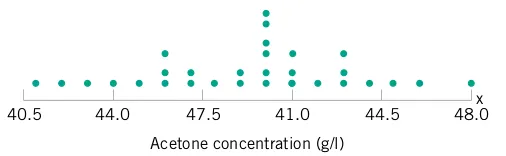
Figure 3: A dot diagram illustrates variation but does not identify the problem.
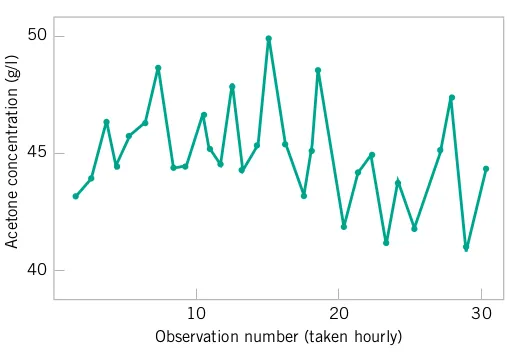
Figure 4: A time series plot of acetone concentration provides more information than the dot diagram.
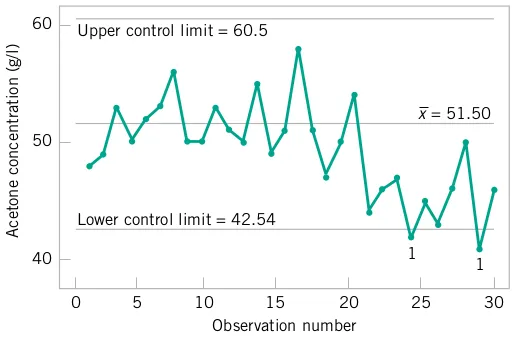
Figure 5: A control chart for the chemical process concentration data.

1.3.1 Control Charts for Process Monitoring

NoteStatistical Process Control

Control Charts are statistical tools used to monitor process performance over time:

Key Components:

  • Center Line: Process average

  • Control Limits: Boundaries for common cause variation

  • Upper Control Limit (UCL): μ + 3σ

  • Lower Control Limit (LCL): μ - 3σ

Types of Control Charts:

  • X̄-Chart: For sample means

  • R-Chart: For sample ranges

  • p-Chart: For proportion defective

  • c-Chart: For count of defects

Interpretation Rules:

  • Points outside control limits indicate special causes

  • Non-random patterns suggest assignable causes

  • Process is “in control” when only common cause variation present

1.3.2 Example: Process Monitoring Over Time

NoteExample: Chemical Process Control

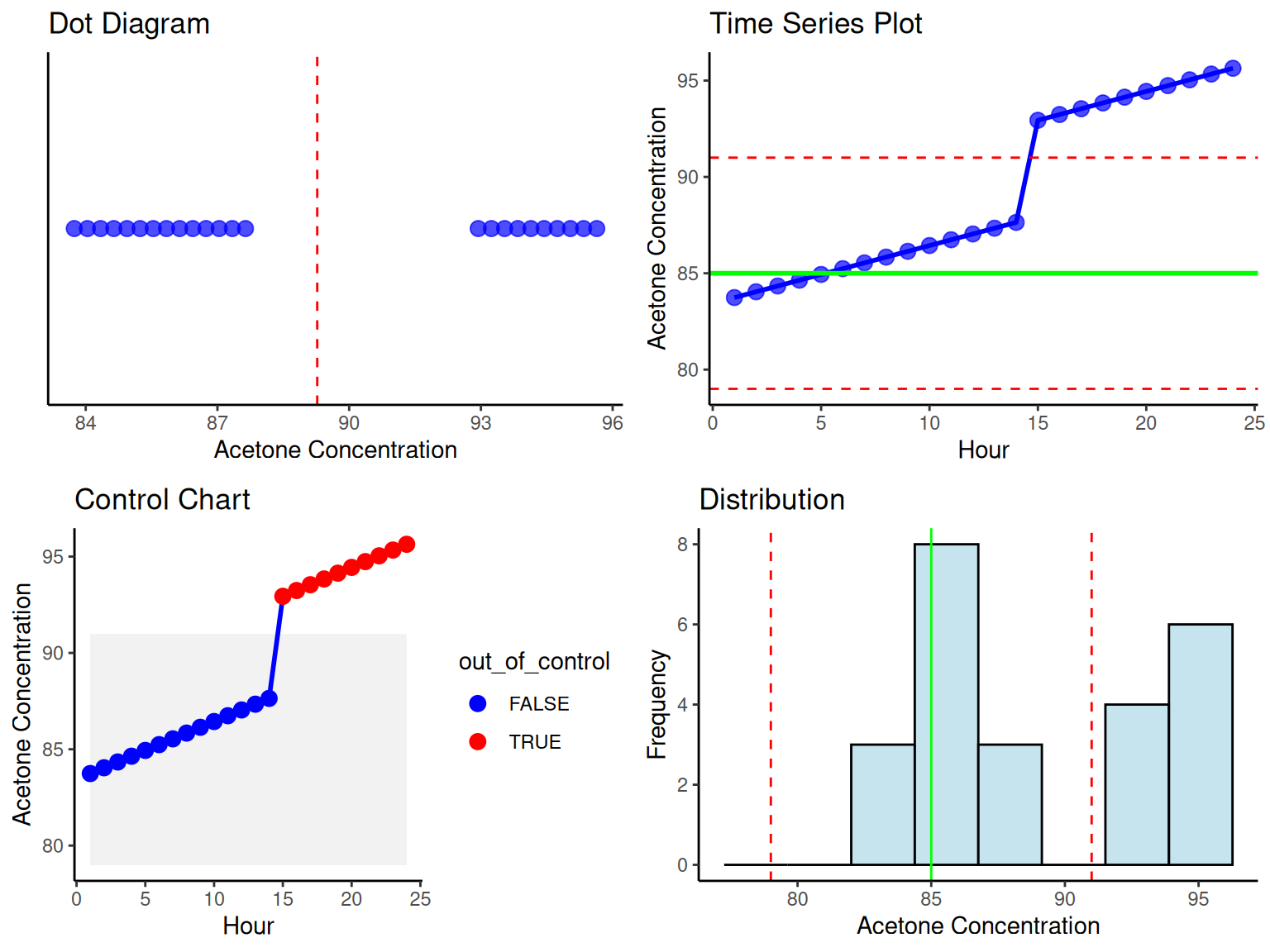
Monitor the output of a chemical process where samples are taken every hour for 24 hours:

Process Summary (24 hours)
samples mean_conc std_conc ooc_points
24 89.27 4.47 10
Figure 6: Process monitoring: dot diagram vs. time series plot

Key Insights from Time Series Plot:

  • Process shows upward trend over time

  • Increased variability in later hours

  • Possible shift at hour 15

  • Need to investigate special causes

Control Chart Analysis:

  • Several points outside control limits

  • Process not in statistical control

  • Corrective action required

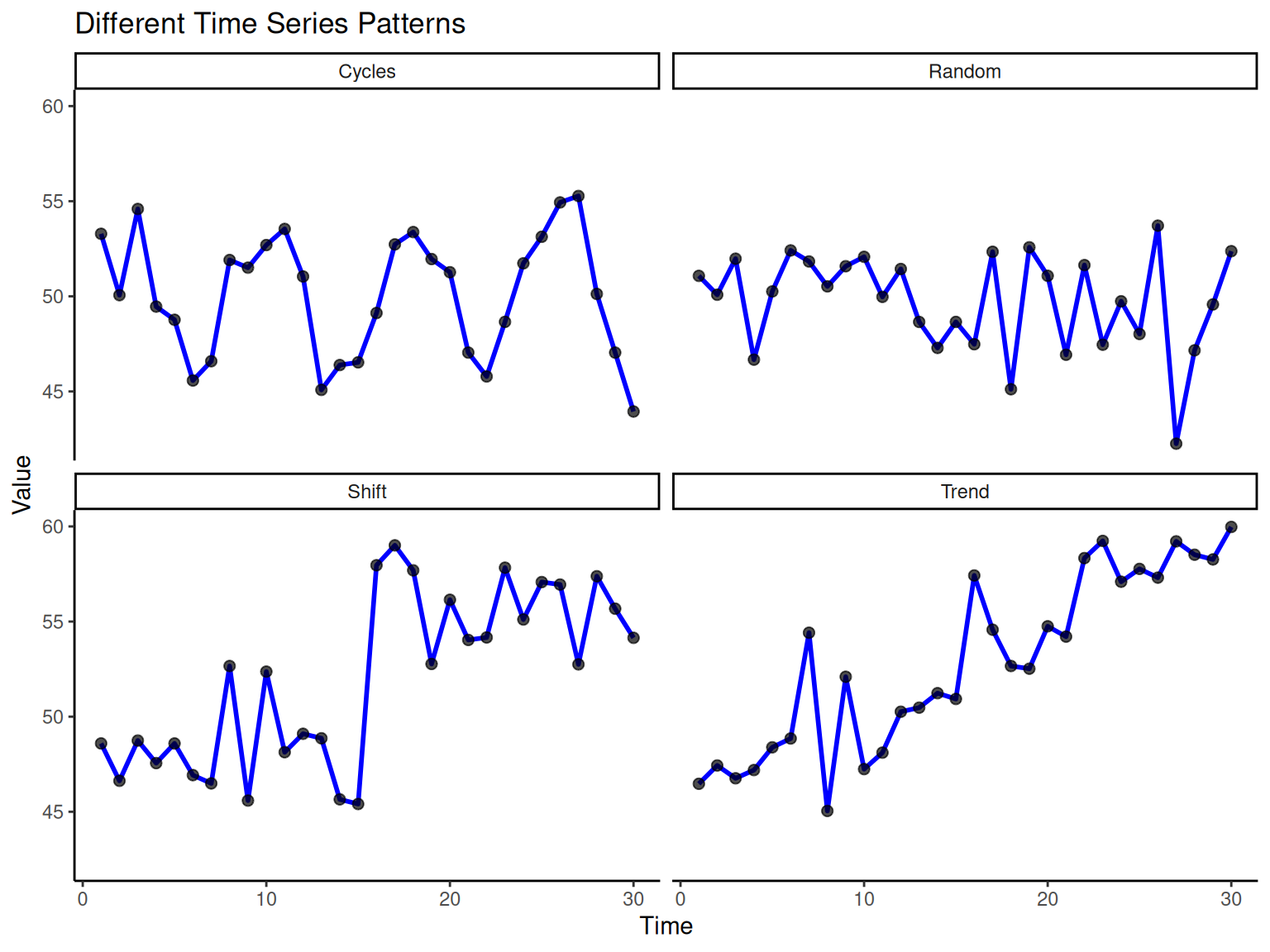
1.3.3 Pattern Recognition in Time Series

NotePattern Recognition

Common Patterns to Look For:

1. Trends

  • Gradual increase or decrease over time

  • May indicate tool wear, drift, or systematic changes

2. Shifts

  • Sudden change in process level

  • Often due to change in materials, operators, or settings

3. Cycles

  • Regular patterns that repeat

  • May be related to temperature, shift changes, or other periodic factors

4. Unusual Points

  • Individual measurements far from typical values

  • May indicate special causes or measurement errors

Statistical Tests for Patterns:

  • Run Test: Tests for randomness

  • Trend Test: Detects systematic trends

  • Shift Test: Identifies level changes

1.3.4 Example: Pattern Recognition

Pattern Analysis Summary
pattern mean_value std_value trend_corr
Cycles 50.10 3.24 -0.06
Random 49.73 2.61 -0.25
Shift 52.00 4.48 0.72
Trend 52.89 4.65 0.90
Figure 7: Different patterns in time series data

1.4 Summary and Key Takeaways

NoteChapter 1 Summary

The Role of Statistics in Engineering:

  1. Problem-Solving Framework: Statistics provides tools for each phase of the engineering method

  2. Data Collection Methods: Retrospective studies, observational studies, and designed experiments each have their place

  3. Understanding Variability: All engineering systems exhibit variability that must be quantified and controlled

  4. Process Monitoring: Time series analysis and control charts enable continuous improvement

Key Principles:

  • Statistical Thinking: Focus on variation, data quality, and continuous improvement

  • Random Sampling: Essential for valid statistical inference

  • Appropriate Methods: Choose data collection method based on objectives and constraints

  • Time Perspective: Always consider how processes behave over time

Practical Applications:

  • Quality control and improvement

  • Process optimization

  • Risk assessment

  • Design verification and validation

  • Reliability analysis

This chapter establishes the fundamental role of statistics in engineering practice, emphasizing the importance of understanding variability, choosing appropriate data collection methods, and thinking statistically about engineering problems.