Modified HP Filter: Theory and Methodology
Muhammad Yaseen
School of Mathematical and Statistical Sciences, Clemson Universitymyaseen208@gmail.com
Javed Iqbal
State Bank of PakistanJaved.iqbal6@sbp.org.pk
M. Nadim Hanif
State Bank of PakistanNadeem.hanif@sbp.org.pk
2026-02-13
Source:vignettes/methodology.Rmd
methodology.RmdIntroduction
This vignette provides a detailed explanation of the methodology
underlying the Modified Hodrick-Prescott (HP) filter as implemented in
the mhpfilter package. We cover the mathematical
foundations, the cross-validation approach for optimal parameter
selection, and empirical evidence supporting its use.
library(mhpfilter)
#> mhpfilter 0.1.0 loaded
library(fastverse)
#> -- Attaching packages --------------------------------------- fastverse 0.3.4 --
#> v data.table 1.18.2.1     v kit        0.0.21
#> v magrittr   2.0.4        v collapse   2.1.6
library(tidyverse)
#> ── Attaching core tidyverse packages ──────────────────────── tidyverse 2.0.0 ──
#> ✔ dplyr     1.2.0     ✔ readr     2.1.6
#> ✔ forcats   1.0.1     ✔ stringr   1.6.0
#> ✔ ggplot2   4.0.2     ✔ tibble    3.3.1
#> ✔ lubridate 1.9.5     ✔ tidyr     1.3.2
#> ✔ purrr     1.2.1
#> ── Conflicts ────────────────────────────────────────── tidyverse_conflicts() ──
#> ✖ dplyr::between()     masks data.table::between()
#> ✖ dplyr::count()       masks kit::count()
#> ✖ tidyr::extract()     masks magrittr::extract()
#> ✖ dplyr::filter()      masks stats::filter()
#> ✖ dplyr::first()       masks data.table::first()
#> ✖ lubridate::hour()    masks data.table::hour()
#> ✖ lubridate::isoweek() masks data.table::isoweek()
#> ✖ lubridate::isoyear() masks data.table::isoyear()
#> ✖ dplyr::lag()         masks stats::lag()
#> ✖ dplyr::last()        masks data.table::last()
#> ✖ lubridate::mday()    masks data.table::mday()
#> ✖ lubridate::minute()  masks data.table::minute()
#> ✖ lubridate::month()   masks data.table::month()
#> ✖ lubridate::quarter() masks data.table::quarter()
#> ✖ tidyr::replace_na()  masks collapse::replace_na()
#> ✖ lubridate::second()  masks data.table::second()
#> ✖ purrr::set_names()   masks magrittr::set_names()
#> ✖ purrr::transpose()   masks data.table::transpose()
#> ✖ lubridate::wday()    masks data.table::wday()
#> ✖ lubridate::week()    masks data.table::week()
#> ✖ lubridate::yday()    masks data.table::yday()
#> ✖ lubridate::year()    masks data.table::year()
#> ℹ Use the conflicted package (<http://conflicted.r-lib.org/>) to force all conflicts to become errors
1. The Standard HP Filter
1.1 Problem Formulation
The Hodrick-Prescott (1997) filter decomposes a time series into a trend component and a cyclical component :
The filter estimates the trend by solving the optimization problem:
This objective function balances two competing goals:
- Goodness of fit: - the trend should be close to the data
- Smoothness: - the trend’s growth rate should not change too rapidly
The smoothing parameter controls the trade-off:
- : Trend equals original series (no smoothing)
- : Trend is a linear time trend (maximum smoothing)
1.2 Matrix Formulation
The solution can be expressed in matrix form. Define the second-difference operator matrix of dimension :
Let . Then the HP filter solution is:
where is the identity matrix.
1.3 The Problem with Fixed Lambda
Hodrick and Prescott (1997) recommended for quarterly U.S. GDP data, based on the assumption that:
“A 5 percent cyclical component is moderately large, as is one-eighth of 1 percent change in the growth rate in a quarter.”
This led to .
However, this assumption may not hold for:
- Different countries (emerging markets have more volatile cycles)
- Different series (investment is more volatile than consumption)
- Different time periods (Great Moderation vs earlier periods)
set.seed(100)
y <- cumsum(rnorm(80)) + 2*sin((1:80)*pi/20)

lambdas <- c(100, 400, 1600, 6400)

# Create data frame for all lambda values
plot_data <- data.frame()

for (lam in lambdas) {
  result <- hp_filter(y, lambda = lam)

  temp_data <- data.frame(
    time = rep(1:length(y), 2),
    value = c(y, result$trend),
    series = rep(c("Original", "Trend"), each = length(y)),
    lambda = paste("λ =", lam)
  )

  plot_data <- rbind(plot_data, temp_data)
}

# Create faceted plot with combined legend
ggplot(plot_data, aes(x = time, y = value, color = series, linewidth = series)) +
  geom_line() +
  scale_color_manual(values = c("Original" = "black", "Trend" = "blue")) +
  scale_linewidth_manual(values = c("Original" = 0.7, "Trend" = 1.2)) +
  facet_wrap(~ lambda, ncol = 2) +
  labs(x = "Time", y = "Value", color = "Series", linewidth = "Series") +
  theme_minimal() +
  theme(legend.position = "bottom",
        strip.text = element_text(size = 10, face = "bold"))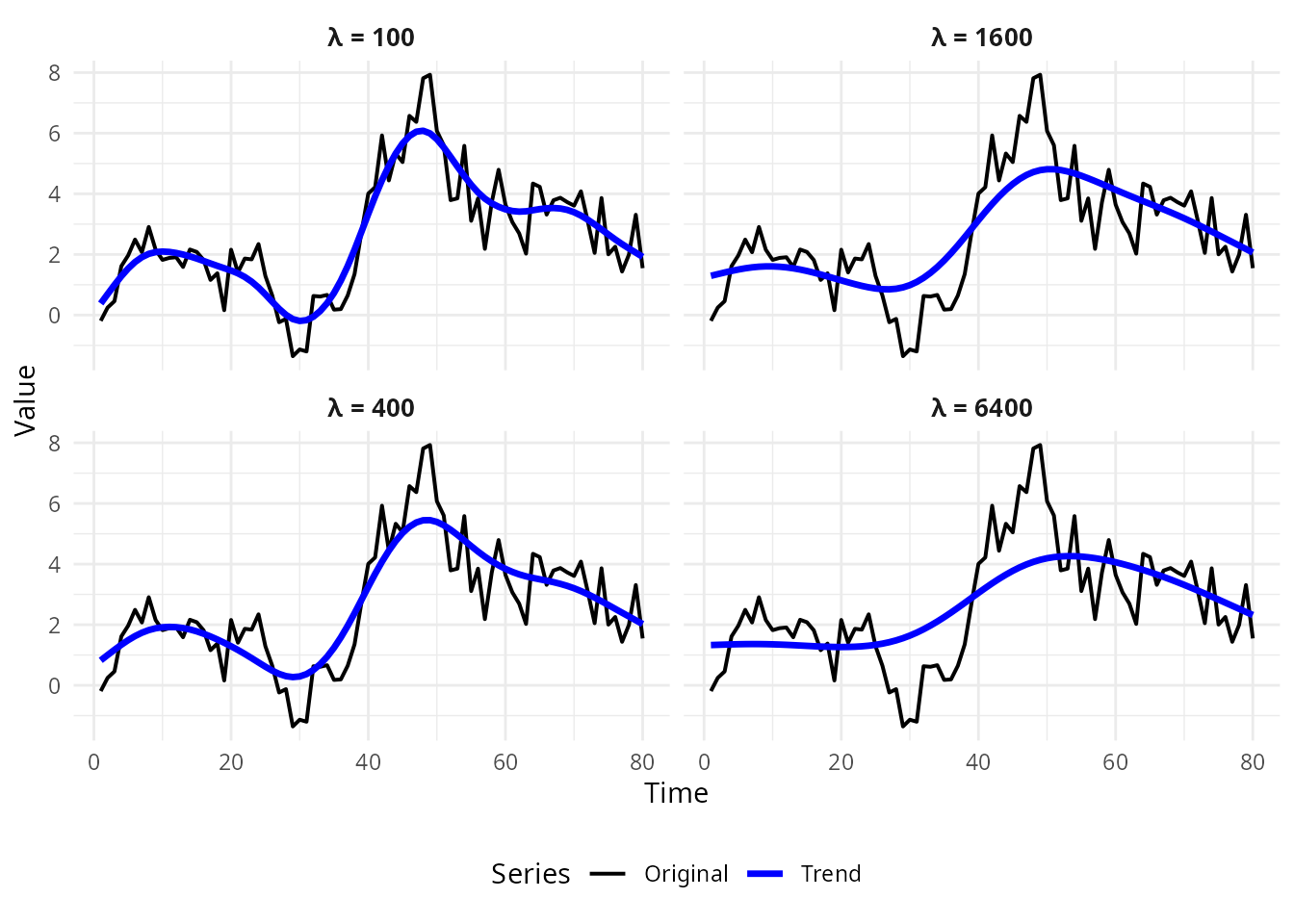
Effect of Lambda on Trend Smoothness
2. The Modified HP Filter
2.1 Cross-Validation Approach
The Modified HP filter, developed by McDermott (1997) and applied empirically by Choudhary, Hanif & Iqbal (2014), selects using generalized cross-validation (GCV).
The idea is based on leave-one-out cross-validation:
- For each observation , fit the HP filter to all data except
- Predict the left-out observation using the fitted trend
- Choose that minimizes the average prediction error
Let denote the predicted value at time from the spline fitted leaving out observation . The cross-validation function is:
2.2 Generalized Cross-Validation
Computing the leave-one-out CV is computationally intensive. Craven & Wahba (1979) showed it can be approximated by the generalized cross-validation (GCV) function:
where is the “hat matrix” and .
Using Silverman’s (1984) approximation for the trace:
This yields the simplified GCV formula used in this package:
2.3 Algorithm
The algorithm implemented in mhpfilter is:
- Compute once (shared across all values)
- For
:
- Compute trend:
- Compute residuals:
- Compute GCV:
- Select
- Return final decomposition using
set.seed(42)
y <- cumsum(rnorm(100, 0.5, 0.3)) + arima.sim(list(ar = 0.8), 100)

# Compute GCV for range of lambdas
lambdas <- seq(100, 5000, by = 50)
gcv_values <- sapply(lambdas, function(lam) {
  res <- hp_filter(y, lambda = lam, as_dt = FALSE)
  T <- length(y)
  resid_ss <- sum((y - res$trend)^2)
  (1 + 2*T/lam) * resid_ss / T
})

# Create data frame for plotting
plot_data <- data.frame(
  lambda = lambdas,
  gcv = gcv_values
)

# Find minimum
opt_idx <- which.min(gcv_values)
opt_lambda <- lambdas[opt_idx]
opt_gcv <- gcv_values[opt_idx]

# Create ggplot
ggplot(plot_data, aes(x = lambda, y = gcv)) +
  geom_line(linewidth = 1.2) +
  geom_vline(xintercept = opt_lambda, color = "red", linetype = "dashed", linewidth = 0.8) +
  geom_point(data = data.frame(lambda = opt_lambda, gcv = opt_gcv),
             aes(x = lambda, y = gcv),
             color = "red", size = 3) +
  # Corrected: Use annotate() instead of geom_label() with aes()
  annotate("label",
           x = opt_lambda + 500,
           y = max(gcv_values) * 0.95,
           label = paste("Optimal λ =", opt_lambda),
           color = "red",
           fill = "white",
           size = 4) +
  labs(
    x = expression(lambda),
    y = "GCV",
    title = "Generalized Cross-Validation Function"
  ) +
  theme_minimal() +
  theme(
    plot.title = element_text(hjust = 0.5, size = 14, face = "bold"),
    axis.title = element_text(size = 12),
    panel.grid.minor = element_blank()
  )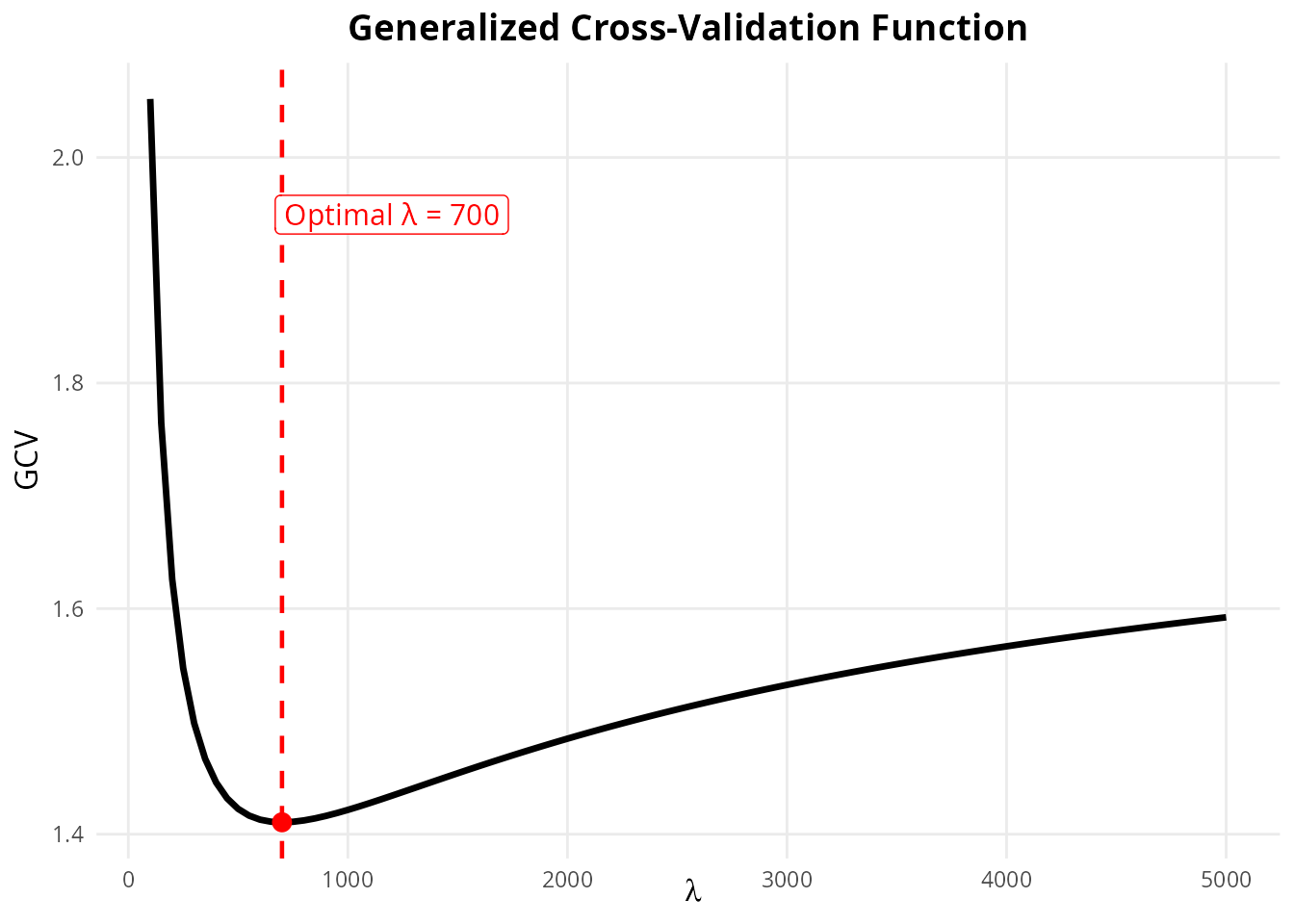
GCV as a Function of Lambda
3. Why Modified HP Filter Works Better
3.1 Simulation Evidence
Choudhary et al. (2014) conducted Monte Carlo simulations comparing the standard HP filter with the Modified HP filter. The data generating process was:
They varied:
- The ratio (relative importance of trend vs cycle)
- AR coefficients (cycle persistence)
- Linear vs nonlinear trend specifications
Key finding: The Modified HP filter produced lower mean squared error in recovering the true cycle in nearly 100% of simulations.
set.seed(2024)
n <- 100

# Generate true components
trend_true <- cumsum(c(0, rnorm(n-1, 0.5, 0.2)))
cycle_true <- arima.sim(list(ar = c(1.2, -0.4)), n, sd = 1.5)
y <- trend_true + cycle_true

# Apply both filters
mhp_result <- mhp_filter(y, max_lambda = 10000)
hp_result <- hp_filter(y, lambda = 1600)

# Compute MSE
mse_mhp <- mean((mhp_result$cycle - cycle_true)^2)
mse_hp <- mean((hp_result$cycle - cycle_true)^2)

oldpar <- par(mfrow = c(1, 1))
plot(cycle_true, type = "l", lwd = 2, ylim = range(c(cycle_true, mhp_result$cycle, hp_result$cycle)),
     main = "True vs Estimated Cycles", ylab = "Cycle")
lines(mhp_result$cycle, col = "blue", lwd = 2)
lines(hp_result$cycle, col = "red", lwd = 2, lty = 2)
legend("topright",
       c(paste0("True Cycle"),
         paste0("MHP (λ=", get_lambda(mhp_result), ", MSE=", round(mse_mhp, 2), ")"),
         paste0("HP (λ=1600, MSE=", round(mse_hp, 2), ")")),
       col = c("black", "blue", "red"), lty = c(1, 1, 2), lwd = 2)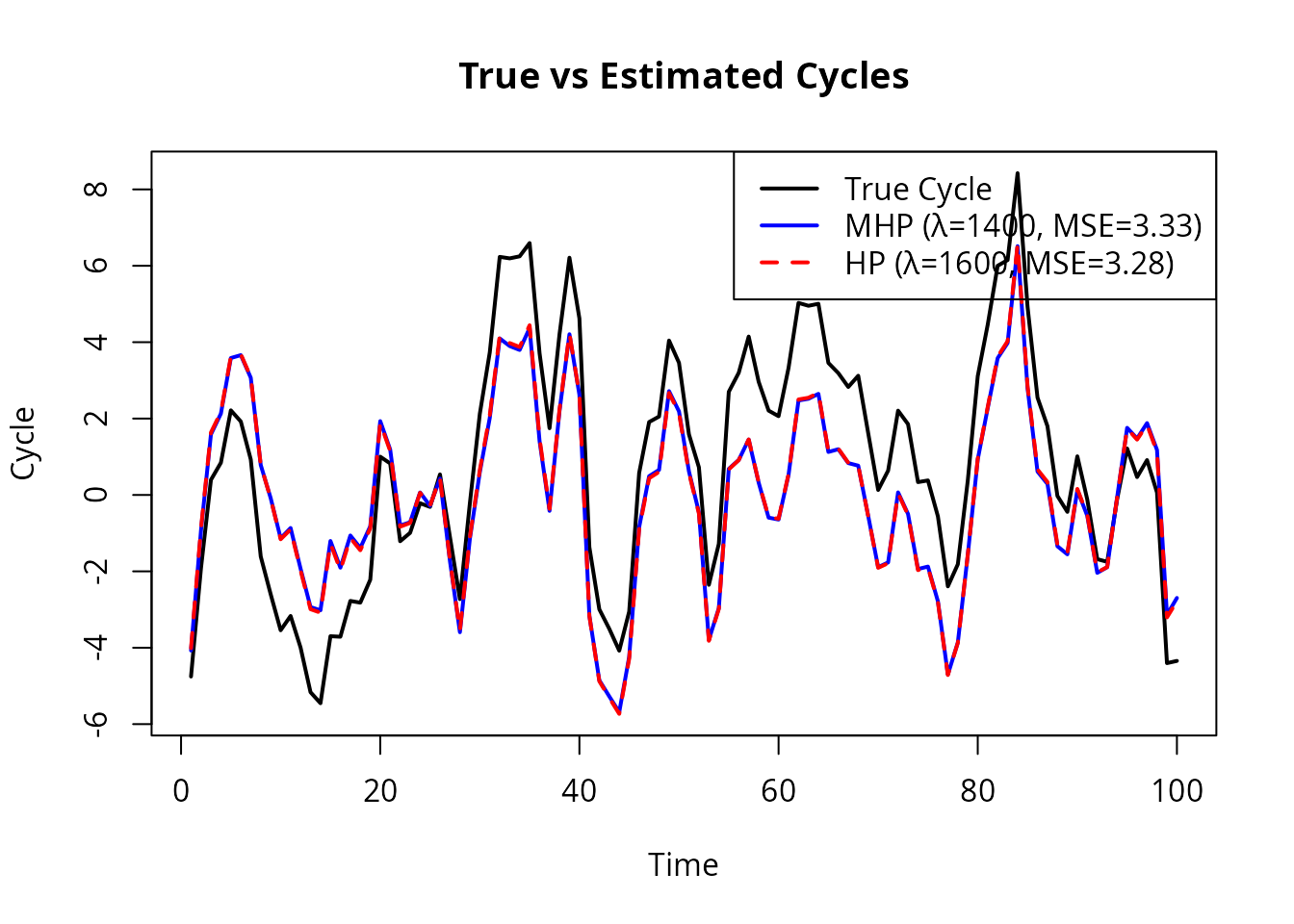
Simulation: True vs Estimated Cycles
par(oldpar)3.2 Empirical Evidence
Choudhary et al. (2014) estimated optimal for 93 countries using annual data and 25 countries using quarterly data. Key findings:
| Statistic | Annual Data | Quarterly Data |
|---|---|---|
| Range of λ | 11 - 6,566 | 229 - 4,898 |
| Fixed λ | 100 | 1,600 |
Implications:
- Optimal varies substantially across countries
- Few countries have close to conventional values
- Standard HP tends to underestimate cyclical volatility (positive
sd_diff) - AR(1) coefficients are relatively robust to filter choice
- Correlations between series can differ significantly
# Demonstrate cross-country variation
set.seed(999)

# Simulate countries with different characteristics
countries <- data.table(
  name = c("Stable_Developed", "Volatile_Emerging", "Moderate"),
  trend_sd = c(0.2, 0.5, 0.3),
  cycle_sd = c(0.5, 2.0, 1.0),
  cycle_ar = c(0.9, 0.7, 0.8)
)

results <- lapply(1:nrow(countries), function(i) {
  trend <- cumsum(rnorm(80, 0.5, countries$trend_sd[i]))
  cycle <- arima.sim(list(ar = countries$cycle_ar[i]), 80, sd = countries$cycle_sd[i])
  y <- trend + cycle
  res <- mhp_filter(y, max_lambda = 10000)
  data.table(country = countries$name[i], lambda = get_lambda(res))
})

print(rbindlist(results))
#>              country lambda
#>               <char>  <int>
#> 1:  Stable_Developed    714
#> 2: Volatile_Emerging    604
#> 3:          Moderate    401
4. Theoretical Justification
4.1 Why Cross-Validation?
Cross-validation is optimal in the sense that it asymptotically minimizes the integrated squared error between the estimated trend and the true trend (Craven & Wahba, 1979).
The GCV function has several desirable properties:
- Rotation invariant: Does not depend on the coordinate system
- Asymptotically optimal: Converges to the best possible
- Computationally efficient: Closed-form approximation available
5. Practical Recommendations
5.1 When to Use Modified HP Filter
Use Modified HP when:
- Analyzing series from different countries (cross-country comparisons)
- Working with different macro variables (GDP, consumption, investment)
- Unsure about appropriate λ for your specific context
- Need defensible, data-driven parameter selection
Standard HP may be acceptable when:
- Following established literature conventions exactly
- Comparing results with published studies using λ = 1600
- Time series closely matches U.S. quarterly GDP characteristics
5.2 Choosing max_lambda
The max_lambda parameter affects computation time and
search range:
| max_lambda | Use Case | Speed |
|---|---|---|
| 5,000 | Quick exploratory analysis | ~0.05s |
| 10,000 | Most quarterly macro series | ~0.1s |
| 50,000 | Conservative, unusual series | ~0.5s |
| 100,000 | Very smooth trends needed | ~1s |
# For most macro applications, 10000 is sufficient
result <- mhp_filter(y, max_lambda = 10000)
cat("Optimal lambda:", get_lambda(result), "\n")
#> Optimal lambda: 1400

# If optimal λ hits the upper bound, increase max_lambda
if (get_lambda(result) >= 9900) {
  warning("Lambda near upper bound - consider increasing max_lambda")
}
5.3 Interpreting Results
Key diagnostics when comparing HP vs Modified HP:
comp <- mhp_compare(y, frequency = "quarterly")
print(comp)
#>         method lambda cycle_sd   cycle_mean       ar1 cycle_range      gcv
#>         <char>  <num>    <num>        <num>     <num>       <num>    <num>
#> 1:          HP   1600 2.444616 1.890115e-12 0.7519842    12.29935       NA
#> 2: Modified HP   1400 2.424745 1.567173e-12 0.7477953    12.20010 6.652109

# Interpretation guide:
# 1. Large lambda difference: series-specific smoothing important
# 2. Positive sd_diff: HP under-estimates cycle volatility
# 3. Large ar1_diff: affects model calibration
6. Mathematical Appendix
References
Choudhary, M.A., Hanif, M.N., & Iqbal, J. (2014). On smoothing macroeconomic time series using the modified HP filter. Applied Economics, 46(19), 2205-2214.
Craven, P., & Wahba, G. (1979). Smoothing noisy data with spline functions. Numerische Mathematik, 31, 377-403.
Hodrick, R.J., & Prescott, E.C. (1997). Postwar US business cycles: An empirical investigation. Journal of Money, Credit and Banking, 29(1), 1-16.
Marcet, A., & Ravn, M.O. (2004). The HP-filter in cross-country comparisons. CEPR Discussion Paper No. 4244.
McDermott, C.J. (1997). An automatic method for choosing the smoothing parameter in the HP filter. Unpublished manuscript, IMF.
Ravn, M.O., & Uhlig, H. (2002). On adjusting the Hodrick-Prescott filter for the frequency of observations. Review of Economics and Statistics, 84(2), 371-376.
Silverman, B.W. (1984). A fast and efficient cross-validation method for smoothing parameter choice in spline regression. Journal of the American Statistical Association, 79, 584-589.