Compare HP and Modified HP filters across multiple time series. Useful for panel data analysis and method validation.
Usage
batch_compare(X, frequency = c("quarterly", "annual"), max_lambda = 100000L)Value
A data.table with comparison metrics for each series:
- series
Series identifier
- hp_lambda
Lambda used for HP filter (1600 or 100)
- mhp_lambda
Optimal lambda from Modified HP
- hp_cycle_sd
Cycle standard deviation (HP)
- mhp_cycle_sd
Cycle standard deviation (Modified HP)
- sd_diff
Difference in cycle SD (MHP - HP)
- hp_ar1
Cycle AR(1) coefficient (HP)
- mhp_ar1
Cycle AR(1) coefficient (Modified HP)
- ar1_diff
Difference in AR(1) (MHP - HP)
- relative_sd
mhp_cycle_sd / hp_cycle_sd
Details
For each series in X, this function: 1. Applies standard HP filter with frequency-appropriate lambda 2. Applies Modified HP filter with GCV optimization 3. Calculates comparison statistics on cyclical components
The comparison helps identify: - Series where Modified HP substantially changes cycle properties - Optimal lambdas across different types of series - Relative performance of automatic vs fixed smoothing
References
Choudhary, M.A., Hanif, M.N., & Iqbal, J. (2014). On smoothing macroeconomic time series using the modified HP filter. Applied Economics, 46(19), 2205-2214.
Examples
# Example 1: Country GDP comparison
set.seed(101)
n <- 80
countries <- c("USA", "UK", "Japan", "Germany", "France", "Italy", "Canada", "Australia")
gdp_data <- sapply(countries, function(ctry) {
  # Varying volatility and persistence
  vol <- runif(1, 0.5, 2.5)
  persist <- runif(1, 0.6, 0.95)
  trend <- cumsum(rnorm(n, 0.5, 0.3))
  cycle <- arima.sim(list(ar = persist), n, sd = vol)
  trend + cycle
})

results <- batch_compare(gdp_data, frequency = "quarterly", max_lambda = 10000)
print(results)
#>       series hp_lambda mhp_lambda hp_cycle_sd mhp_cycle_sd      sd_diff
#>       <char>     <num>      <int>       <num>        <num>        <num>
#> 1:       USA      1600       1317   1.4234427    1.4087969 -0.014645761
#> 2:        UK      1600       6923   2.2501287    2.3141371  0.064008449
#> 3:     Japan      1600        811   0.8679768    0.8203508 -0.047626003
#> 4:   Germany      1600        688   0.7904605    0.7248391 -0.065621379
#> 5:    France      1600       1702   2.5930919    2.6000972  0.007005289
#> 6:     Italy      1600        637   2.9063951    2.6832130 -0.223182177
#> 7:    Canada      1600       2408   1.2925740    1.3098183  0.017244216
#> 8: Australia      1600       1368   2.3354516    2.3167453 -0.018706327
#>       hp_ar1   mhp_ar1     ar1_diff relative_sd
#>        <num>     <num>        <num>       <num>
#> 1: 0.4634548 0.4536856 -0.009769214   0.9897110
#> 2: 0.4198404 0.4488474  0.029006967   1.0284466
#> 3: 0.6439636 0.6064673 -0.037496385   0.9451299
#> 4: 0.5337024 0.4488174 -0.084884984   0.9169834
#> 5: 0.5734333 0.5755733  0.002140053   1.0027015
#> 6: 0.6713875 0.6145662 -0.056821328   0.9232100
#> 7: 0.4037357 0.4199658  0.016230111   1.0133410
#> 8: 0.3748145 0.3661056 -0.008708860   0.9919903

# Example 2: Sectoral analysis with visualization
set.seed(2024)
n_time <- 100
sectors <- c("Tech", "Finance", "Energy", "Healthcare", "Consumer")
sector_returns <- matrix(rnorm(n_time * length(sectors)), nrow = n_time)

# Add sector-specific characteristics
for (i in 1:length(sectors)) {
  drift <- runif(1, -0.1, 0.3)
  volatility <- runif(1, 0.5, 2.0)
  sector_returns[, i] <- cumsum(rnorm(n_time, mean = drift / 100, sd = volatility / 100)) +
    runif(1, 0.5, 2) * sin(2 * pi * (1:n_time) / (20 + i * 3))
}
colnames(sector_returns) <- sectors

sector_comparison <- batch_compare(sector_returns, frequency = "quarterly", max_lambda = 5000)

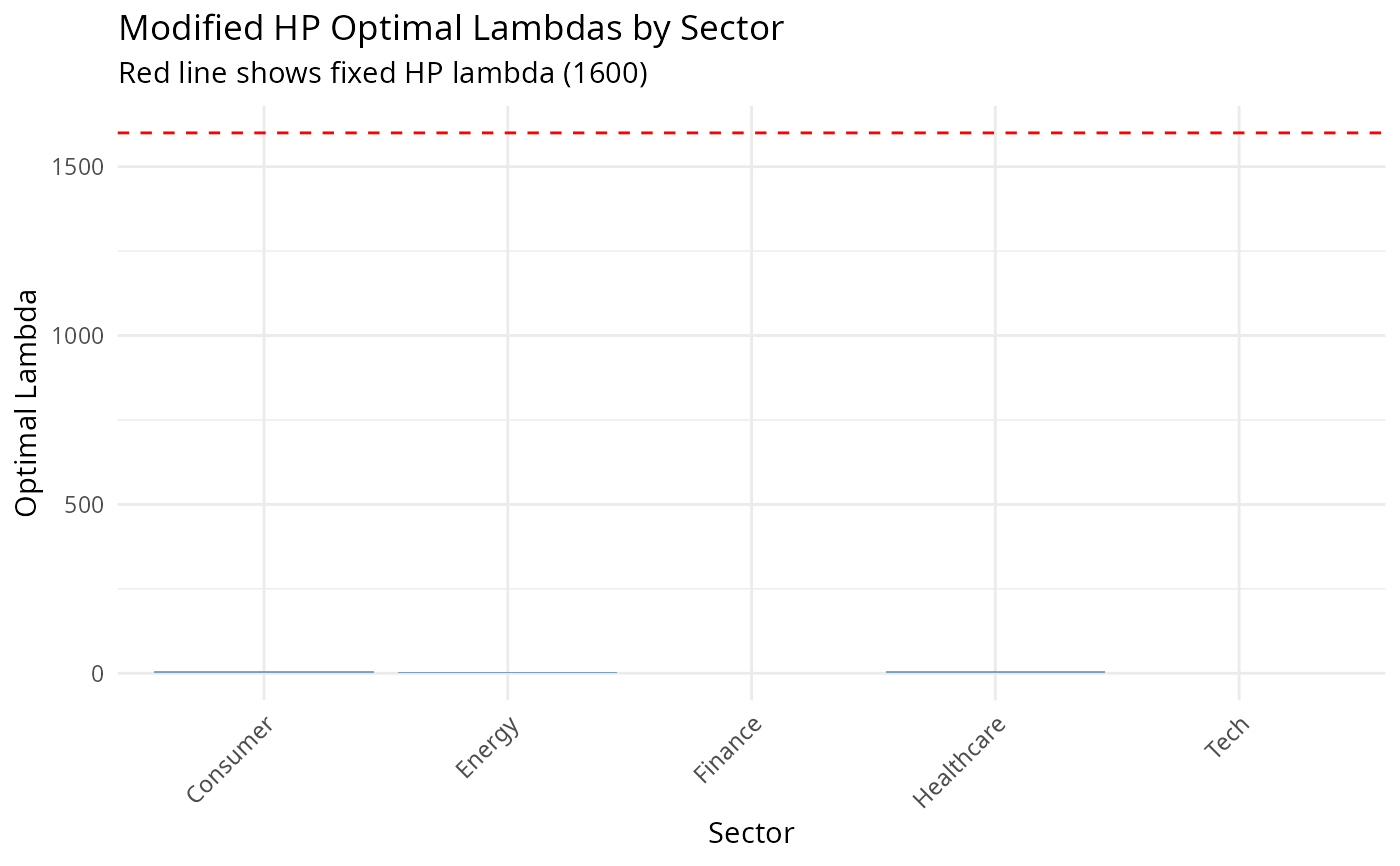
if (require(ggplot2)) {
  # Plot lambda comparison
  lambda_plot <- ggplot2::ggplot(
    sector_comparison,
    ggplot2::aes(x = series, y = mhp_lambda)
  ) +
    ggplot2::geom_col(fill = "steelblue", alpha = 0.7) +
    ggplot2::geom_hline(yintercept = 1600, linetype = "dashed", color = "red") +
    ggplot2::labs(
      title = "Modified HP Optimal Lambdas by Sector",
      subtitle = "Red line shows fixed HP lambda (1600)",
      x = "Sector", y = "Optimal Lambda"
    ) +
    ggplot2::theme_minimal() +
    ggplot2::theme(axis.text.x = ggplot2::element_text(angle = 45, hjust = 1))

  print(lambda_plot)
}