The Role of Statistics in Engineering

Engineering Problem-Solving Through Statistical Thinking

M. Yaseen

School of Mathematical and Statistical Sciences
Clemson University

Welcome to Engineering Statistics!

Statistics: The Science of Uncertainty

  • Engineering Method: Systematic problem-solving approach
  • Data-Driven Decisions: Transform uncertainty into actionable insights
  • Variability Management: Understanding and controlling variation
  • Process Monitoring: Continuous improvement through data

Why Statistics Matters in Engineering:

  • Quality Control: Ensure products meet specifications
  • Process Optimization: Improve efficiency and performance
  • Risk Assessment: Quantify and manage uncertainty
  • Design Validation: Verify engineering solutions work

Modern Engineering Reality

Today’s engineers must navigate uncertainty, manage variability, and make data-driven decisions in increasingly complex systems.

Learning Objectives

Statistical Foundations:

  1. Role of Statistics in engineering problem-solving
  2. Variability Impact on data and decision-making
  3. Population vs Sample concepts and applications
  4. Random Variables and sources of variability

Practical Applications:

  1. Statistical Reasoning and the data-to-wisdom pipeline
  2. Parameters vs Statistics - inference fundamentals
  3. Descriptive vs Inferential statistics
  4. Engineering Examples with real-world applications

Goal: Develop statistical reasoning skills essential for modern engineering practice.

The Engineering Method and Statistical Thinking

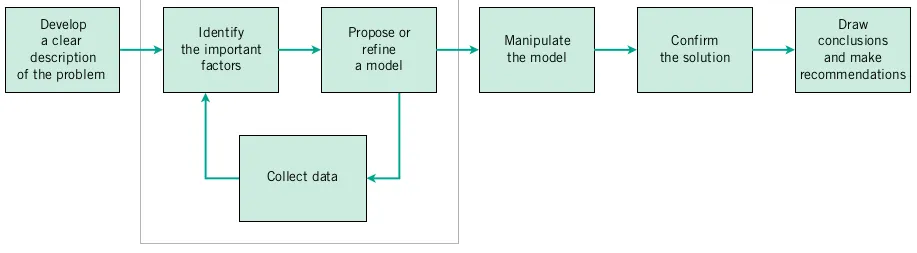
The Engineering Problem-Solving Method

Traditional 8-Step Process:

  1. Problem Description - Clear, concise definition
  2. Factor Identification - What affects the problem?
  3. Model Proposal - Scientific/engineering knowledge
  4. Experimentation - Test and validate hypotheses
  5. Model Refinement - Based on observed data
  6. Solution Development - Manipulate model for solutions
  7. Solution Validation - Confirm effectiveness
  8. Conclusions - Recommendations and decisions

Statistical Integration:

  • Step 1-2: Pattern recognition in data
  • Step 3: Statistical models and relationships
  • Step 4: Designed experiments and sampling
  • Step 5: Data analysis and model fitting
  • Step 6: Optimization and prediction
  • Step 7: Validation and testing
  • Step 8: Uncertainty quantification

Key Insight: Statistics isn’t separate from engineering - it’s integral to every step!

Engineering Foundation

The Engineering Problem-Solving Method

Engineering Foundation: Engineers solve problems of interest to society by the efficient application of scientific principles. The engineering or scientific method is the approach to formulating and solving these problems.

Statistical Integration: In today’s data-driven engineering environment, statistical methods are essential tools that complement traditional engineering analysis, helping engineers make sense of uncertain, variable data and draw reliable conclusions.

The engineering problem-solving method

Statistics in Engineering Problem-Solving

1. Problem Recognition and Definition

  • Helps identify patterns in data that indicate problems
  • Quantifies the magnitude and frequency of issues
  • Provides tools for problem prioritization

2. Hypothesis Formation

  • Uses data analysis to suggest potential causes
  • Applies statistical models to test theories
  • Employs correlation analysis to identify relationships

3. Data Collection and Analysis

  • Designs efficient experiments and sampling plans
  • Provides methods for data quality assessment
  • Offers tools for exploratory data analysis

4. Conclusion and Decision Making

  • Quantifies uncertainty in results
  • Provides confidence intervals and hypothesis tests
  • Enables risk-based decision making

Manufacturing Process Investigation

Engineering Example: Statistical Problem-Solving

Example: Manufacturing Process Investigation

Engineering Context: A manufacturing engineer notices increased variability in product dimensions, which could lead to quality issues and customer complaints. This demonstrates systematic application of statistical methods to engineering problem-solving.

[1] "Manufacturing Problem Example - Step by Step Analysis"
Variability Comparison Between Time Periods
period count mean_dimension std_dev min_value max_value
First_Half 15 50.322 0.148 50.172 50.587
Second_Half 15 49.731 0.138 49.528 49.976
Analysis by Operator
operator count mean_dimension std_dev
A 10 49.940 0.290
B 10 50.206 0.327
C 10 49.934 0.332
[1] "Temperature-Dimension Correlation: 0.249"

Statistical Analysis Steps:

  1. Problem Recognition: Control charts show process instability
  2. Hypothesis Formation: Possible causes include temperature, operator, or material variation
  3. Data Collection: Design experiment to test factors systematically
  4. Analysis and Conclusion: Statistical tests identify significant factors

Probability and Statistics Fundamentals

Probability: Quantifying Uncertainty

Probability Concepts:

  • Used to quantify likelihood or chance
  • Used to represent risk or uncertainty in engineering applications
  • Can be interpreted as our degree of belief or relative frequency

Key Probability Concepts:

  • Sample Space (S): Set of all possible outcomes
  • Event (A): Subset of the sample space
  • Probability P(A): Measure of likelihood, where 0 ≤ P(A) ≤ 1

Engineering Applications:

  • Reliability analysis: P(component failure)
  • Quality control: P(defective product)
  • Risk assessment: P(system malfunction)
  • Design optimization: P(meeting specifications)
  • Safety analysis: P(hazardous events)

Statistics: The Science of Learning from Data

Statistics Definition:

Deals with the collection, presentation, analysis, and use of data to:

  • Make decisions
  • Solve problems
  • Design products and processes

Statistical techniques are useful for describing and understanding variability.

Variability in Engineering:

By variability, we mean successive observations of a system or phenomenon do not produce exactly the same result.

Statistics gives us a framework for:

  • Describing this variability
  • Learning about potential sources of variability
  • Making decisions despite uncertainty

Statistical Reasoning

The Art and Science of Learning from Data

Statistics is the science of uncertainty & variability

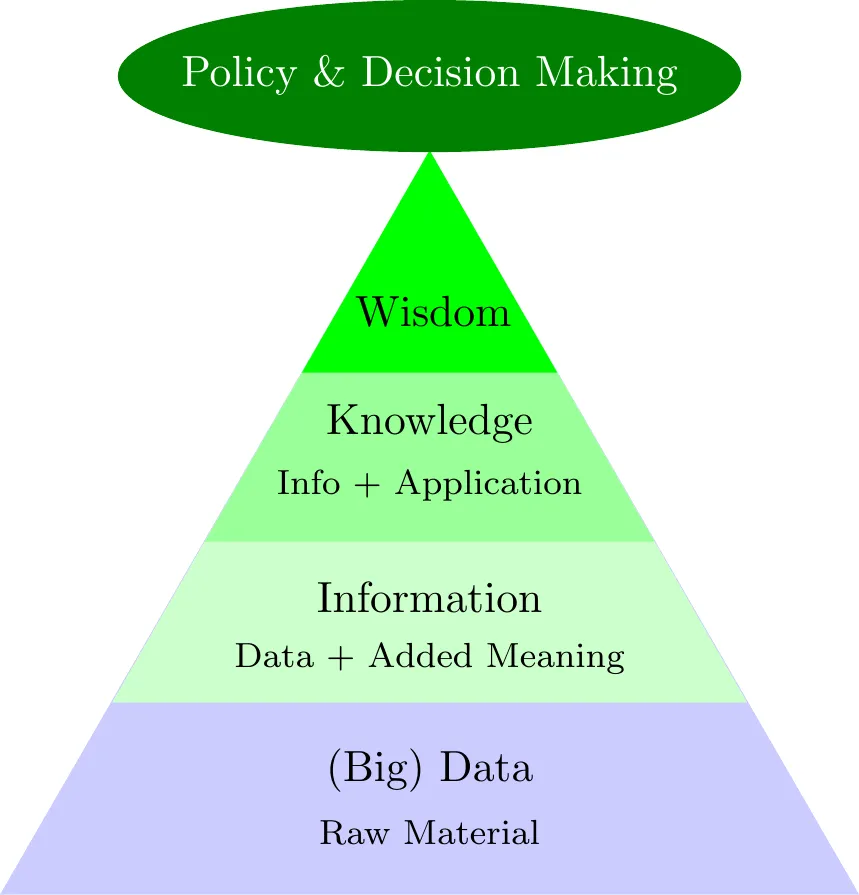
Turning Data into Information:

DataInformationKnowledgeWisdom

The Statistical Thinking Process:

  1. Recognize the need for data-based decisions
  2. Understand the importance of data quality
  3. Appreciate the role of variability
  4. Use appropriate statistical methods
  5. Communicate results effectively

Big Data in Engineering

Statistics is the Art and Science of learning from Data.

Key Definitions and Concepts

Population vs. Sample

Population

  • Set of measurements of interest
  • Characteristics of the population (parameters) are typically of interest
  • Usually unknown and must be estimated

Sample

  • Subset of measurements of interest
  • A characteristic of the sample (statistic) is used to infer population characteristics (parameters)
  • Observable and computable

Parameter

  • A characteristic of the population (usually unknown and estimated from sample data)
  • Examples: μ, σ, π

Statistic

  • A characteristic of the sample (computed from observed data)
  • Examples: x̄ ,s ,p

Types of Statistical Analysis

Descriptive Statistics

  • Describing the important characteristics of a set of data
  • Measures of central tendency (mean, median, mode)
  • Measures of variability (standard deviation, range)
  • Graphical displays (histograms, box plots)
  • Summary tables and charts

Inferential Statistics

  • Using sample data to make inferences (or generalizations) about a population
  • Hypothesis testing
  • Confidence intervals
  • Regression analysis
  • Analysis of variance (ANOVA)

Statistical Inference: Making a statement about the population (parameter) based on the sample (statistic)

O-Ring Development Example

Population vs. Sample in Practice

Example: O-Ring Development for Semiconductor Equipment

Engineering Context: An engineer is developing a rubber compound for use in O-rings. The O-rings are to be employed as seals in plasma etching tools used in the semiconductor industry, so their resistance to acids and other corrosive substances is an important characteristic.

The engineer uses the standard rubber compound to produce eight O-rings in a development laboratory and measures the tensile strength of each specimen after immersion in a nitric acid solution at 30°C for 25 minutes.

Data: The tensile strengths (in psi) of the eight O-rings are: 1030, 1035, 1020, 1049, 1028, 1026, 1019, and 1010

O-Ring Sample Statistics & Confidence Interval
sample_size sample_mean sample_median sample_std_dev sample_min sample_max std_error t_value margin_error ci_lower ci_upper
8 1027.1 1027 11.7 1010 1049 4.14 2.36 9.8 1017.3 1036.9

Analysis of O-Ring Data

Statistical Components:

  • Population: All possible O-rings made with this rubber compound
  • Sample: The eight O-rings tested (n = 8)
  • Parameter: True mean tensile strength (μ) of all O-rings
  • Statistic: Sample mean tensile strength (x̄ = 1027.1 psi)

Key Observation:

As we should have anticipated, not all the O-ring specimens exhibit the same measurement of tensile strength.

This demonstrates the fundamental concept of variability in engineering measurements.

Engineering Insight

The variation in tensile strength is not a measurement error - it’s real variability that must be understood and managed in the engineering design process.

Random Variables and Variability

Understanding Random Variables

Random Variable Concept:

Since tensile strength varies or exhibits variability, it is a random variable.

A random variable X can be modeled by:

\[X = \mu + \epsilon\]

where μ is a constant and ε is a random disturbance, or “noise” term.

Sources of Variability:

  • Common Causes: Natural variation inherent in the process
  • Special Causes: Unusual events that create additional variation
  • Measurement Error: Variation due to measurement system
  • Environmental Factors: Temperature, humidity, vibration effects

Engineering Application

Understanding sources of variability helps engineers design more robust processes and make better decisions under uncertainty.

Summary and Key Takeaways

The Statistical Foundation of Modern Engineering

Core Concepts Mastered:

  • Engineering Method: Statistics integrated in every step
  • Variability: The reality of engineering measurements
  • Population vs Sample: Foundation of statistical inference
  • Random Variables: Mathematical framework for uncertainty

Practical Skills Developed:

  • Statistical Thinking: Data-driven problem solving
  • Parameter Estimation: Sample statistics to infer population parameters
  • Variability Analysis: Understanding sources and impacts
  • Decision Making: Under uncertainty with confidence